


Lifetime Warranty
35+5 uF MFD 370/440 VAC Dual Run Round Capacitor - Fits AC Unit Fan Motor, Heat Pump - Replaces 97F9834 - 2 Pack
Save 13%
0.00
Regular price
$37.67
Regular price
$43.32
Sale price
$37.67
Fast delivery
CONFIRM THE FIT FOR YOUR MODEL
Enter your model number
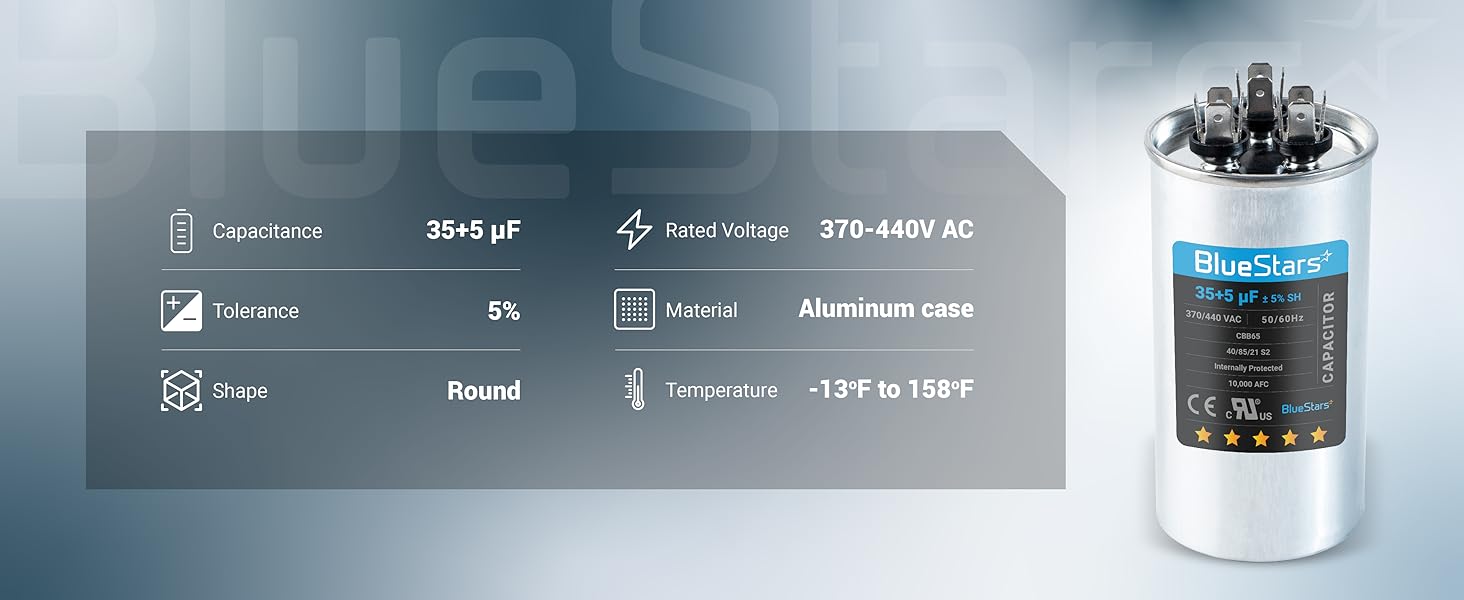
35+5 MFD uF 370 VAC or 440 Volt Dual Run Round Capacitor
Key Features
- Capacitance: 35/5 Microfarad (MFD)
- Tolerance: ±5%
- Voltage Rating: 370V or 440V AC (dual rated)
- Frequency: 50/60 Hz
- Shape: Round
- Case Material: Aluminum
- Terminals: 1/4 inch male quick-connect (3 terminals: C, HERM, F)
- Operating Temperature: -40°C to +70°C (-40°F to +158°F)
- Dimensions: 2 in. diameter x 4.75 in. height
Replaces / Cross-Reference Part Numbers
- Replaces any round dual run capacitor with matching 35/5 MFD and 370V or 440V specifications.
- Direct replacement for capacitors labeled 35+5 MFD, 35/5 µF, or similar variations.
- Always verify capacitance (MFD), voltage (V), and physical dimensions before ordering.
Compatibility & Fitment
- Used in air conditioning units, heat pumps, condenser fan motors, and compressors.
- Combines two capacitors into one unit to power a compressor motor (HERM) and a fan motor (F).
- Compatible with units from various manufacturers that require a capacitor with matching specifications.
When to Replace
- Compressor or fan motor hums but does not start.
- AC unit runs intermittently or fails to start.
- Air conditioner blows warm air.
- Visible signs of failure on the existing capacitor, such as a bulging or swollen top, leaking oil, or heavy corrosion.
Installation Tips
- WARNING: Disconnect all electrical power to the HVAC unit before beginning installation.
- Capacitors store an electrical charge. Safely discharge the old capacitor by shorting the terminals with an insulated screwdriver.
- Note or photograph the wire placement on the C (Common), HERM (Hermetic/Compressor), and F (Fan) terminals before disconnecting.
- Connect the wires to the corresponding terminals on the new capacitor.
- Secure the new capacitor using the existing mounting strap or bracket.


-

Step 1
Turn off the power and locate the capacitor -

Step 2
Discharge any stored electricity by shorting the terminals -

Step 3
Take a photo or note how the wires connect. Disconnect wires & install the new capacitor. -

Step 4
Reassemble and test