Lifetime Warranty

35+3 uF MFD 370/440 VAC Dual Run Round Capacitor CBB65 - Fits Condenser, Heat Pump - 2 Pack

Save 13%
0.00 Regular price
$36.09
Regular price $41.50 Sale price
$36.09
In stock
Fast delivery

Secure and trusted checkout with

  • Visa
  • Mastercard
  • American Express
  • PayPal
  • Diners Club
  • Discover
Contact for wholesale

🛠️
CONFIRM THE FIT FOR YOUR MODEL
Enter your model number

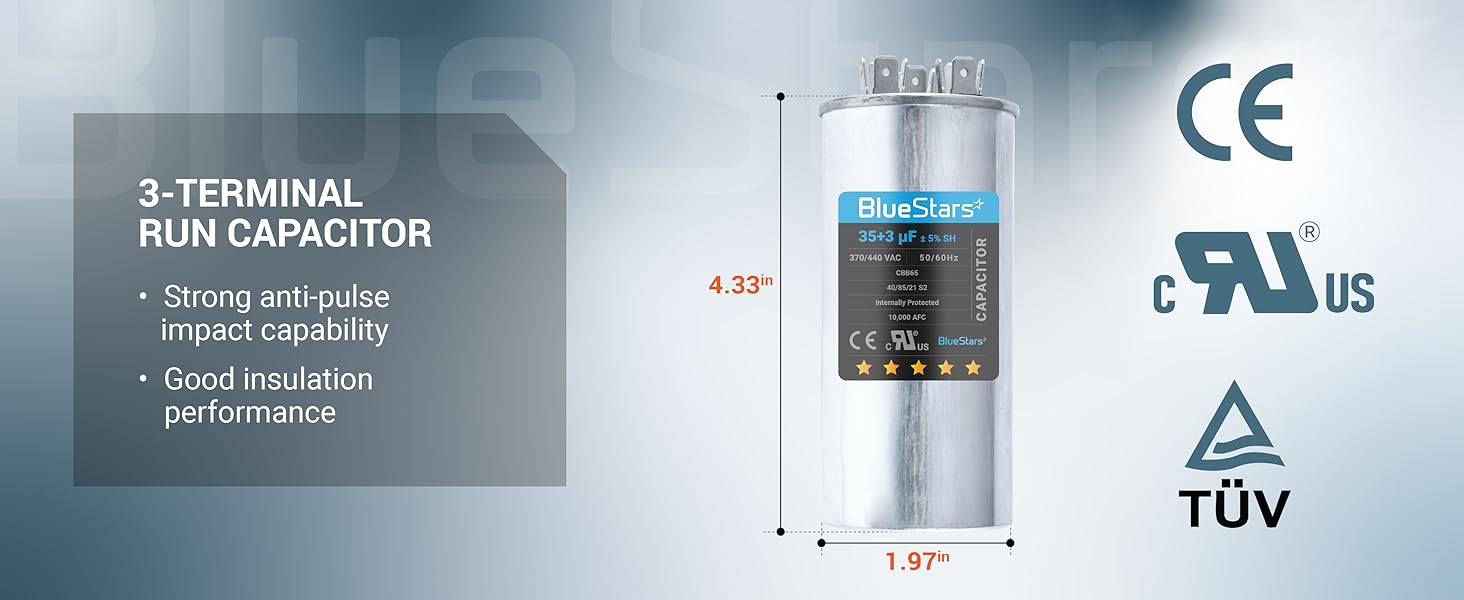
35+3 MFD uF 370/440 Volt Dual Run Round Capacitor CBB65

Key Features

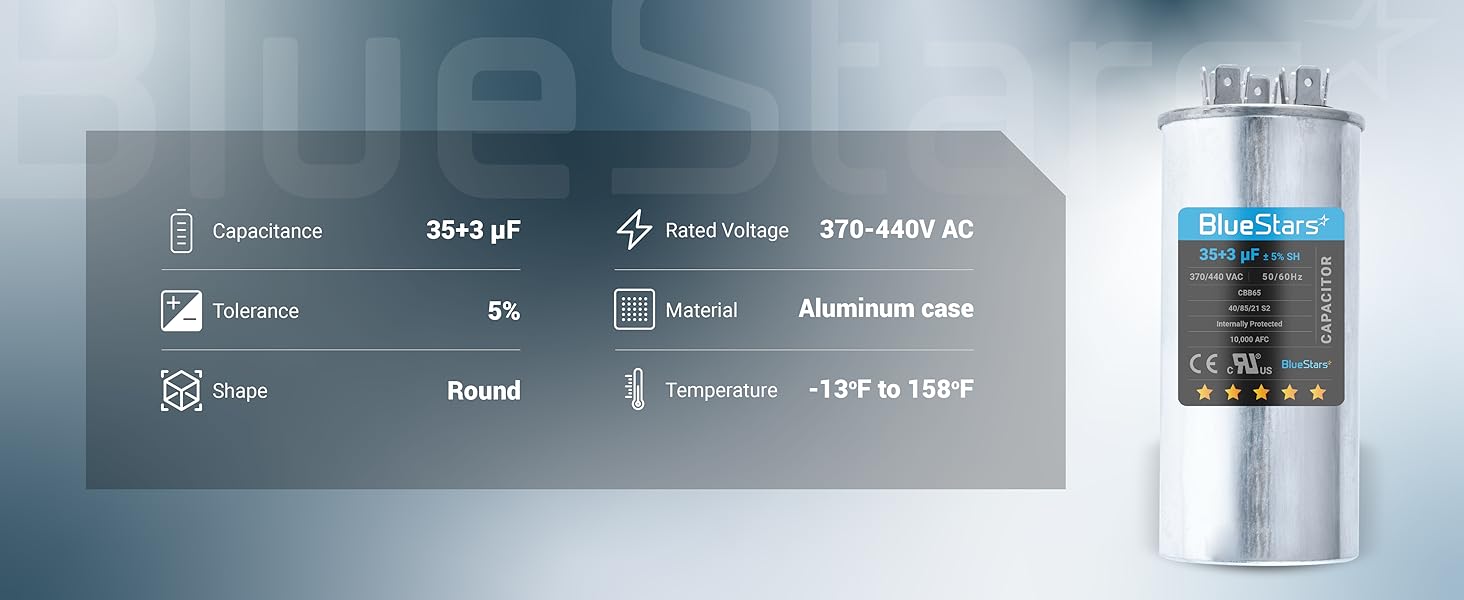
  • Capacitance: 35 + 3 Microfarad (MFD/uF)
  • Tolerance: ±6%
  • Voltage Rating: 370V or 440V AC
  • Frequency: 50/60 Hz
  • Shape: Round
  • Terminals: 3 (HERM, FAN, C)
  • Operating Temperature: -40°C to +70°C
  • Construction: Metal case, oil-filled

Replaces / Cross-Reference Part Numbers

  • Replaces any dual run round capacitor with matching 35/3 MFD capacitance and 370 VAC or 440 VAC voltage ratings. The physical dimensions should also be compatible with the mounting bracket.

Compatibility & Fitment

  • Used in HVAC systems, air conditioners, heat pumps, and furnaces.
  • Powers a compressor motor (HERM) and a fan motor (FAN) simultaneously.
  • Verify the MFD rating, voltage, and physical size of your original capacitor before ordering. A capacitor with a 440V rating can replace one with a 370V rating, but not vice-versa.

When to Replace

  • Motor hums but does not start.
  • Fan or compressor struggles to start or runs slowly.
  • AC unit is not cooling effectively.
  • Visible signs of failure on the old capacitor, such as a swollen or bulging top, or leaking fluid.

Installation Tips

  • Disconnect all electrical power to the unit before servicing.
  • Safely discharge the existing capacitor by shorting the terminals with an insulated-handle screwdriver.
  • Photograph or make a note of the wire connections before disconnecting them.
  • Connect wires to the correct terminals: 'HERM' for the compressor, 'FAN' for the fan motor, and 'C' for the common line.
Product image
Product image
Product image
Product image
  • Step 1

    Step 1

    Turn off the power and locate the capacitor
  • Step 2

    Step 2

    Discharge any stored electricity by shorting the terminals
  • Step 3

    Step 3

    Take a photo or note how the wires connect. Disconnect wires & install the new capacitor.
  • Step 4

    Step 4

    Reassemble and test

FAQ

A failing capacitor often causes the AC unit or heat pump to struggle to start, resulting in a humming sound from the compressor or fan motor without the unit actually engaging. You may also notice the fan spinning slowly, the unit blowing warm air, or the system frequently tripping its circuit breaker. If the top of the capacitor appears domed or bulging, it is a clear sign that the internal pressure has compromised the component and it requires immediate replacement.
Yes, this capacitor is designed to be a universal replacement for both 370 VAC and 440 VAC applications. The 440 VAC rating indicates it can handle higher voltage spikes, making it a robust and compatible substitute for systems originally equipped with 370 VAC capacitors.
This unit replaces a wide range of industry-standard capacitors, including OEM part numbers USA2226BA, C4353, C3353, 43-23204-04, 14077, 12977, 12730, 12082, 12077, 97F9472, 97F9472BX, and 328P3503H44N37A5Z9. As long as your existing capacitor is rated for 35+3 uF, this part will function correctly regardless of the brand name printed on the original label.
Safety is the priority. Before touching the capacitor, ensure the power to the HVAC unit is completely disconnected at the main breaker. Capacitors can store a lethal electrical charge even when the power is off; use an insulated screwdriver to short across the terminals to safely discharge any remaining energy before handling the wires.
Replacing a dual run capacitor is a straightforward task that typically takes 15 to 30 minutes. You will need a screwdriver to remove the access panel, a pair of needle-nose pliers for the wire terminals, and an insulated screwdriver for discharging the old capacitor. It is helpful to take a photo of the existing wiring configuration before disconnecting the old unit to ensure the wires (Herm, Fan, and Common) are reconnected to the correct terminals on the new capacitor.
The most common causes for capacitor failure are excessive heat, power surges, and age. HVAC capacitors operate in harsh outdoor environments, and over time, the internal dielectric material degrades. Keeping the condenser coils clean and free of debris helps the unit run more efficiently, which reduces the thermal stress on the capacitor and can extend its service life.