Lifetime Warranty

25+5 uF MFD ±5% 370/440 VAC CBB65 50/60 Hz Dual Run Start Round Air Conditioner Capacitor - Fits AC Unit Fan Motor, Heat Pump

Save 13%
0.00 Regular price
$17.26
Regular price $19.85 Sale price
$17.26
Out of stock
Fast delivery

Secure and trusted checkout with

  • Visa
  • Mastercard
  • American Express
  • PayPal
  • Diners Club
  • Discover
Contact for wholesale

🛠️
CONFIRM THE FIT FOR YOUR MODEL
Enter your model number

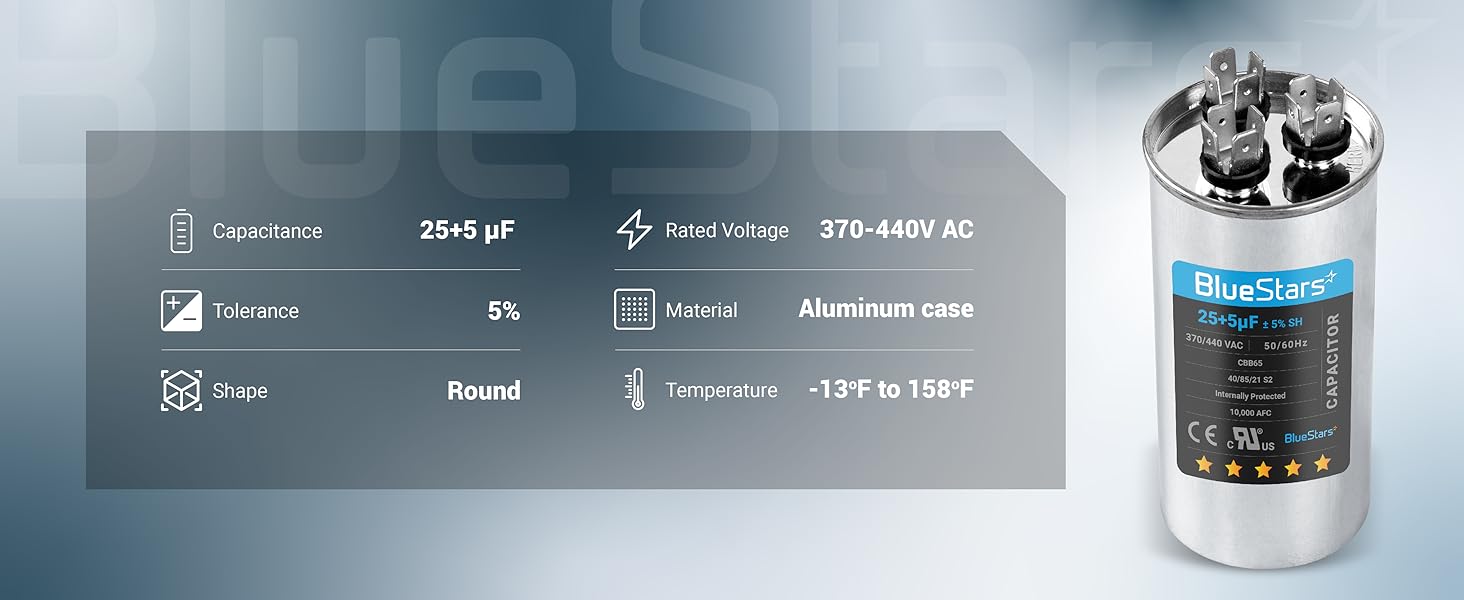
25+5 uF 370-440 VAC Volts ±5% Round Run Capacitor

Key Features

  • Capacitance: 25/5 Microfarad (uF/MFD)
  • Voltage Rating: Dual 370 or 440 Volts AC
  • Tolerance: ±5%
  • Frequency: 50/60 Hz
  • Shape: Round
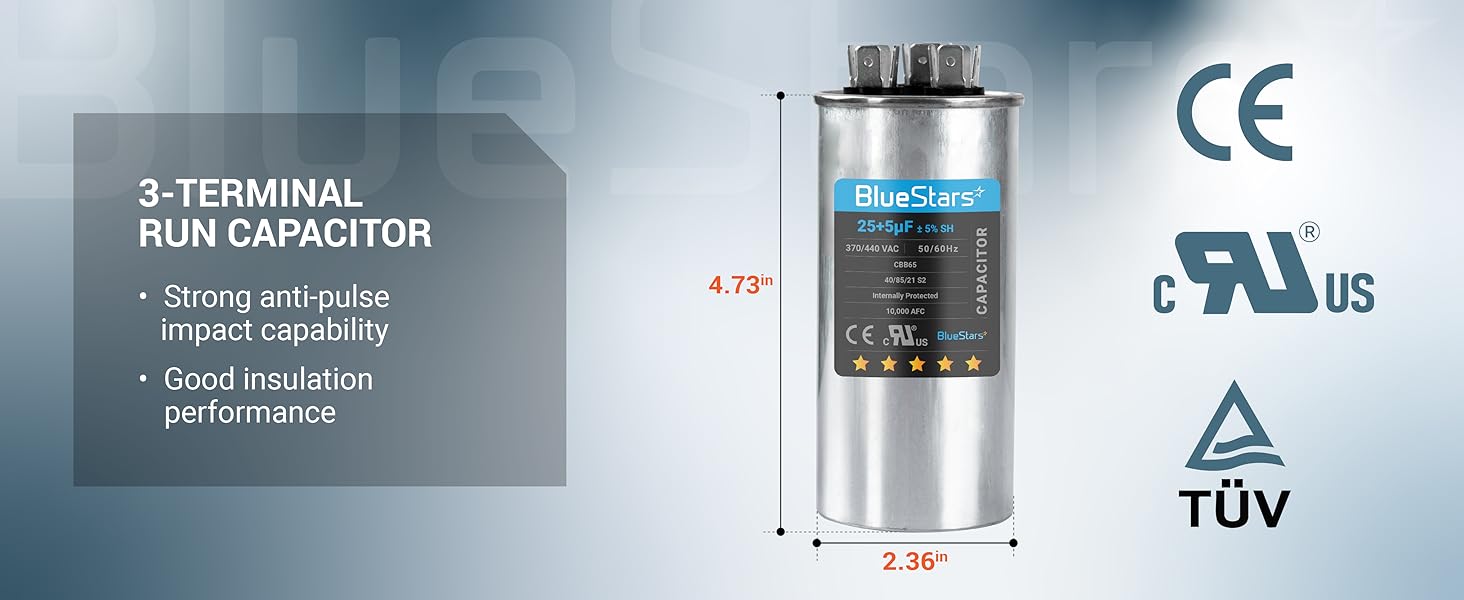
  • Terminals: 3 (C, FAN, HERM)
  • Operating Temperature: -40 °C to +70 °C
  • Type: CBB65 Dual Run Capacitor

Replaces / Cross-Reference Part Numbers

  • Goodman: CAP050250440RSP
  • USA2225
  • Also replaces any 25+5, 25/5, or 25-5 MFD round capacitor with a 370V or 440V rating.

Compatibility & Fitment

  • Designed for HVAC systems, including air conditioners and heat pumps.
  • Simultaneously runs a compressor motor (25 uF) and a fan motor (5 uF).
  • Physical dimensions must match the existing capacitor for proper mounting. Verify diameter and height before ordering.

When to Replace

  • Outdoor unit hums but the fan or compressor does not start.
  • Fan runs but the compressor does not engage.
  • Capacitor case is visibly swollen, bulging, or leaking fluid.
  • Capacitance reading is outside the ±5% tolerance when tested with a multimeter.

Installation Tips

  • Disconnect all electrical power to the HVAC unit before starting work.
  • Safely discharge the existing capacitor by shorting the terminals with an insulated-handle screwdriver.
  • Note or photograph the wire placement on the old capacitor's C, FAN, and HERM terminals.
  • Connect the wires to the corresponding terminals on the new capacitor.
  • Secure the new capacitor with the original mounting bracket.
Product image
Product image
Product image
Product image
  • Step 1

    Step 1

    Turn off the power and locate the capacitor
  • Step 2

    Step 2

    Discharge any stored electricity by shorting the terminals
  • Step 3

    Step 3

    Take a photo or note how the wires connect. Disconnect wires & install the new capacitor.
  • Step 4

    Step 4

    Reassemble and test

FAQ

Common symptoms of a failing capacitor include the AC unit failing to start, a humming sound coming from the condenser unit without the fan spinning, or the fan starting only after being manually pushed. You may also notice the top of the capacitor is domed or bulging, which indicates it has failed internally and needs immediate replacement.
Yes. A capacitor rated for 440 VAC is perfectly safe to use in a system originally designed for 370 VAC. The voltage rating indicates the maximum voltage the capacitor can handle; using a higher voltage rating is acceptable and often provides better durability against power surges.
This is a dual-run capacitor. It contains two separate capacitors in one housing: one 25 microfarad (uF) section used to start and run the compressor, and one 5 microfarad (uF) section used to run the fan motor. It is critical to match these exact microfarad ratings to ensure your motor and compressor operate at the correct torque and speed.
Installation typically takes 15 to 30 minutes. You will need a screwdriver to remove the access panel and a pair of needle-nose pliers to disconnect the spade terminals. Always ensure the power to the HVAC unit is turned off at the breaker before beginning. It is highly recommended to discharge the old capacitor with an insulated screwdriver across the terminals before handling it, as it can hold a dangerous electrical charge even when the power is off.
If you are replacing a failed capacitor, it is a good practice to inspect the contactor for pitted or burnt points. If the contactor is worn, it may cause the new capacitor to fail prematurely. Additionally, ensure the fan motor spins freely by hand; if the motor bearings are seized, a new capacitor will not solve the issue.