


Lifetime Warranty
50+10 uF MFD ±5% 370/440 VAC CBB65B Dual Run Start Round Capacitor - Fits Condenser, Heat Pump
Save 25%
0.00
Regular price
$21.67
Regular price
$28.89
Sale price
$21.67
Fast delivery
CONFIRM THE FIT FOR YOUR MODEL
Enter your model number
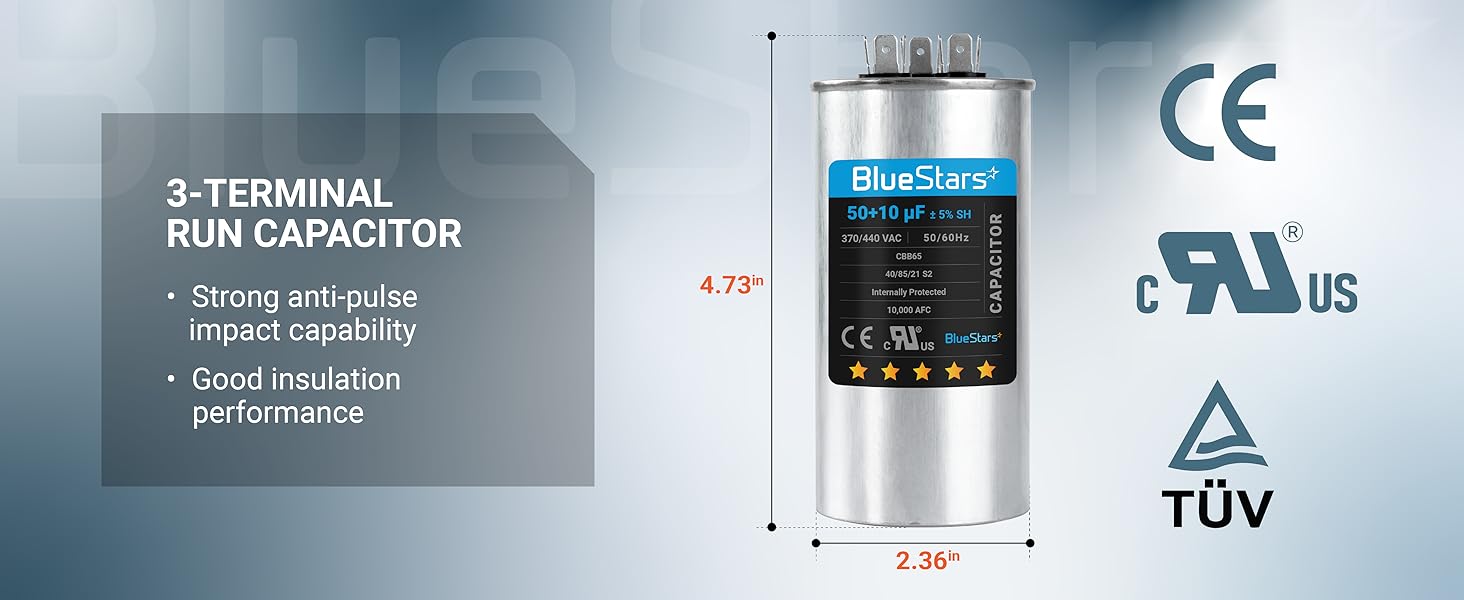
50+10 uF MFD ±5% 370/440 VAC CBB65B Dual Run Start Round Capacitor
Key Features
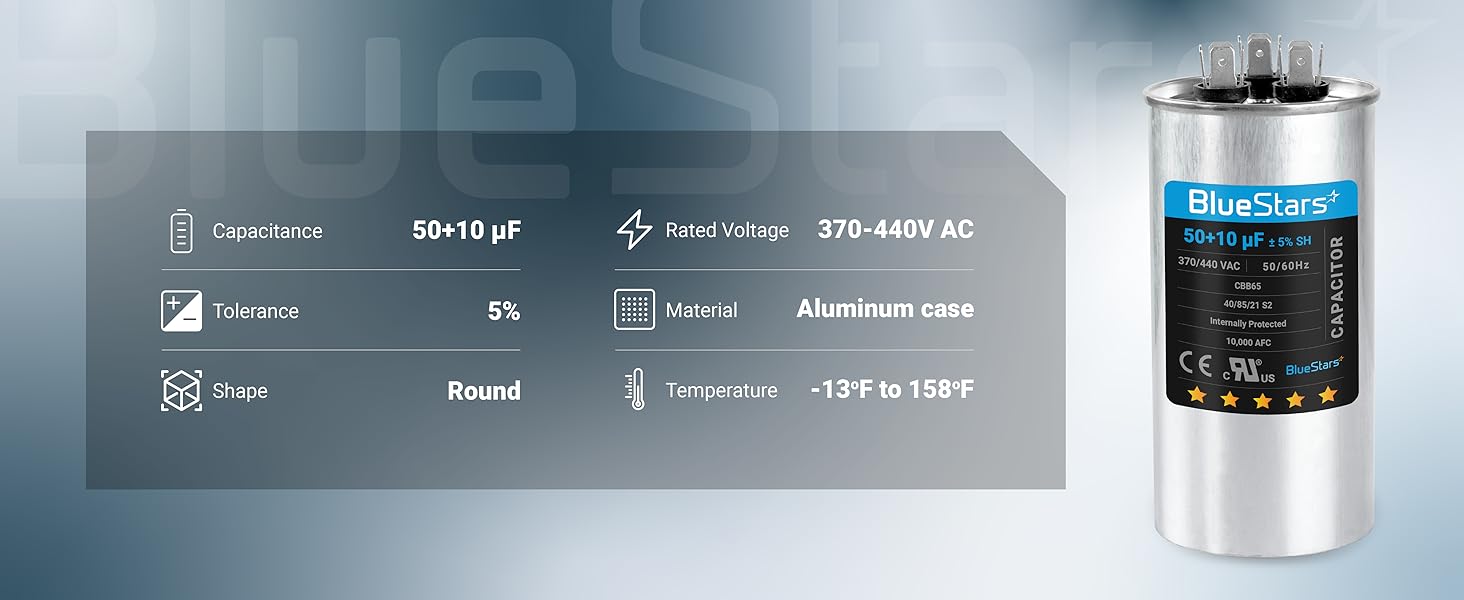
- Capacitance: 50 + 10 Microfarad (uF/MFD)
- Voltage Rating: 370 / 440 Volts AC (VAC)
- Capacitance Tolerance: ±5%
- Operating Frequency: 50 / 60 Hz
- Shape: Round
- Terminals: 3 (Common, Fan, Hermetic Compressor)
- Construction: Metal housing, oil-filled
- Operating Temperature Range: -25°C to +70°C
Replaces / Cross-Reference Part Numbers
- Directly replaces any round dual-run capacitor with identical 50+10 uF capacitance and 370V or 440V ratings.
- Compatible with capacitors in the CBB65 series.
- Cross-reference: 97F9895, Z97F995, 97F9895BZ3, 27L880, TRCD455, TRCFD455, PRCFD455, 27L889, 97F9851, 97F9851S, 12788, RC0114, Z97F9895, 97F9895, TT-CAP-45/5/440R, HC98KA046, TP-CAP-45/5/440R, CAP050450440RT, HC98JA046, HCKS450D050R440Z, 00662441180262.
Compatibility & Fitment
- Designed for starting and running single-phase AC motors.
- Commonly used in air conditioning units, heat pumps, condenser units, and furnace blower motors.
- Serves both the compressor motor (50 uF) and the fan motor (10 uF) in a single component.
When to Replace
- Motor hums but does not start.
- Fan runs slower than normal or needs a manual push to start.
- Compressor fails to engage.
- Visible signs of damage such as bulging, cracking, or leaking fluid from the capacitor case.
- Capacitance measures outside the specified tolerance range when tested.
Installation Tips
- Disconnect all power to the equipment before beginning work.
- Safely discharge the existing capacitor by shorting across the terminals with an insulated tool.
- Verify that the voltage and microfarad (uF) ratings match the original capacitor.
- Note the wire placement on the old capacitor's terminals (C, FAN, HERM) before disconnecting.
- Ensure all wire connections are secure before restoring power.


-

Step 1
Turn off the power and locate the capacitor -

Step 2
Discharge any stored electricity by shorting the terminals -

Step 3
Take a photo or note how the wires connect. Disconnect wires & install the new capacitor. -

Step 4
Reassemble and test